
The Leica Noctilux 1:1.2/50mm — A Complete Guide to Every Variation
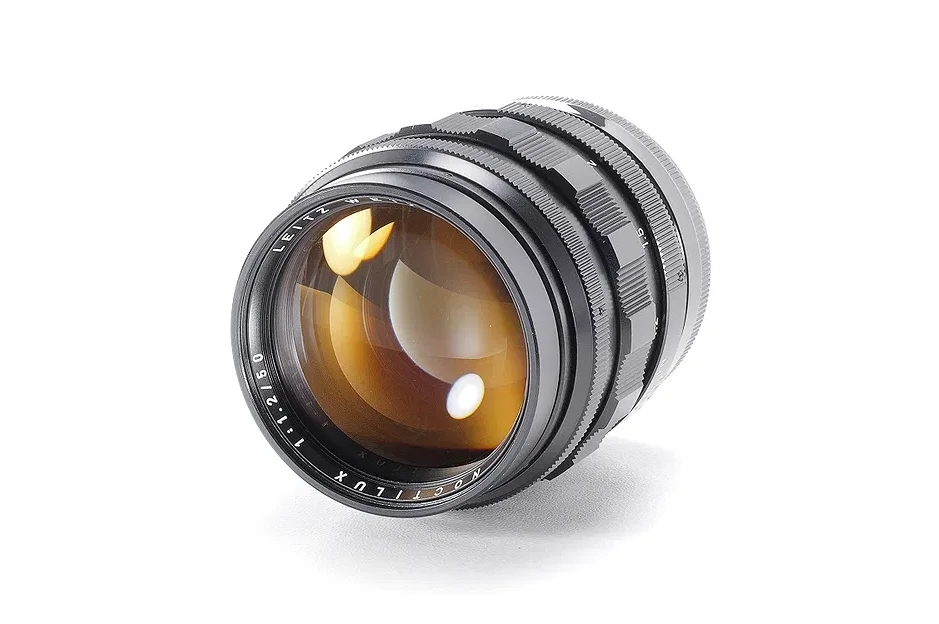
Not because it was produced in great numbers — it was not. Not because it was widely used — it was far too rare and far too expensive for that. The first-generation Noctilux matters because it represented something that had never been done before at scale: a production lens with hand-polished aspherical elements, built by a small team of specialists on a single machine in Wetzlar, pushed to the very edge of what optical manufacturing could achieve in the mid-1960s.
To own any version of the f/1.2 Noctilux is to own a piece of that ambition. To understand the differences between them is to understand one of the most remarkable production histories in Leica’s story.
The Name and What It Means
Before the history, a detail that matters. Noctilux is a compound of two Latin roots: Nocti, derived from nocturnal, and Lux, meaning light. Light of the night. It was the right name for a lens designed to work where other lenses failed — in theaters, concert halls, candlelit rooms, and streets after dark. It was also, in hindsight, the perfect name for a lens that would become one of the most mythologized in collecting history.
The Road to f/1.2 — A Decade of Development
The Noctilux did not arrive suddenly. Work on aspherical lens surfaces at Leitz in Wetzlar began as early as 1957. The first result was a prototype Summaron 35 mm f/2.8 featuring two aspherical surfaces, produced in 1958 — but it never reached commercial production. A more ambitious 52 mm f/1.0 prototype with two aspherical surfaces followed in 1959, but was abandoned: the image quality wide open was deemed insufficient, and the manufacturing process was not yet mature enough to achieve consistency.
The project was not abandoned. It was refined. The first prototypes of what would become the Noctilux were produced in April 1964, designed by Helmut Marx and Paul Sindel. Marx was generally regarded as the successor to Professor Max Berek as head of photographic lens design at Leitz in Wetzlar — the same role that had produced the Summicron, the Summaron, and much of the optical vocabulary of the M system. The decision was also made to step back from f/1.0 to f/1.2, accepting a marginal loss of speed in exchange for substantially better optical performance wide open.
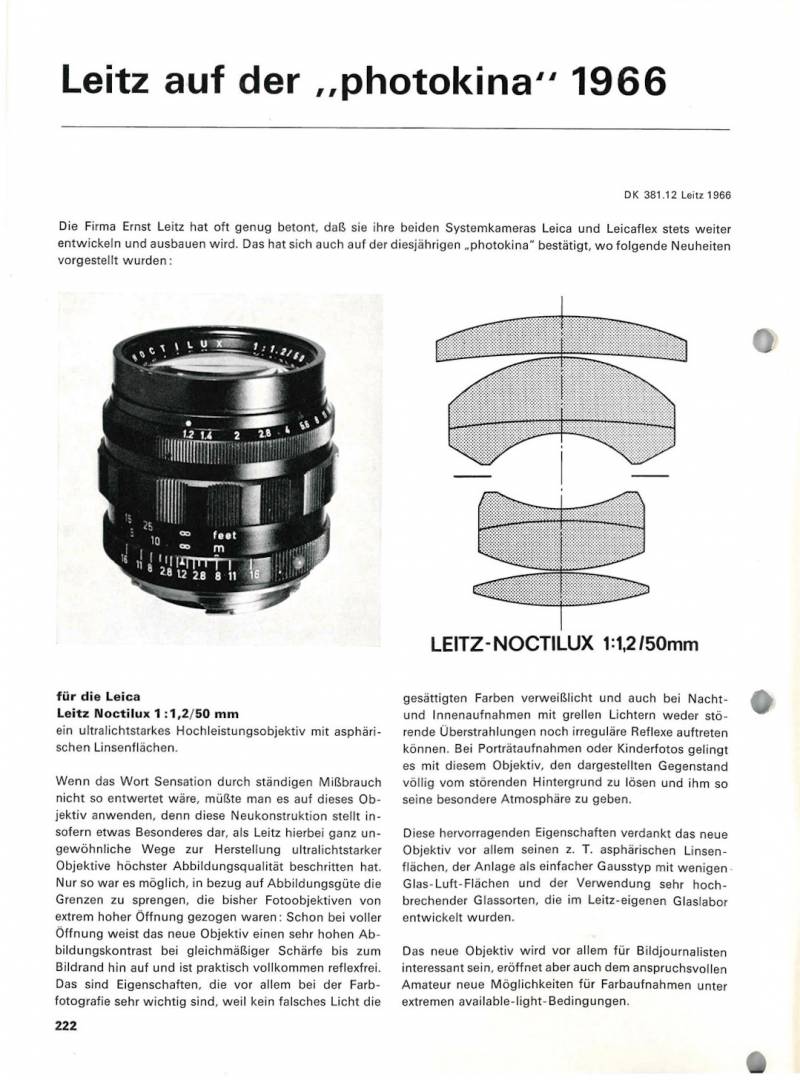
By the time the lens debuted at Photokina in Cologne in 1966, it was ready — and it was unlike anything else on a trade fair table.
Marx designed the lens with the help of an Elliott 402F computer for ray tracing — years before he developed his COMO lens-optimization program in the late 1960s. The production lens reached the market as the model 11820 in 1966.
The Competitive Context
Leica was not the only manufacturer chasing maximum aperture in the 1960s. By the time the Noctilux appeared, Canon had already released a 58mm f/1.2 in 1962 and Nikon hit the market with a 55mm f/1.2 in 1965. What separated the Leitz lens was not the aperture figure alone. It was the aspherical elements — a manufacturing achievement none of the competition had matched — and the specific rendering character that resulted from them.
One Machine, a Few Hands
The engineering achievement behind the Noctilux rests on a manufacturing detail that is almost impossible to appreciate without knowing it: the two hand-ground aspherical elements — one front, one rear — were made on a specially built grinding machine that had to be operated manually. There were only a few people in the entire factory capable of operating it. They had to discard many elements along the way. Each aspherical surface took approximately 40 hours to produce, and no two elements were precisely alike. This is why the production rate was so low, and why the total output across the entire nine-year production run was so small.
This bottleneck also explains something important about the rendering character of the original f/1.2: the slight variation between examples, the specific micro-contrast behavior at wide apertures, the quality that experienced users describe as impossible to replicate exactly. Each lens is, in a meaningful sense, slightly different from every other.
The Optical Formula
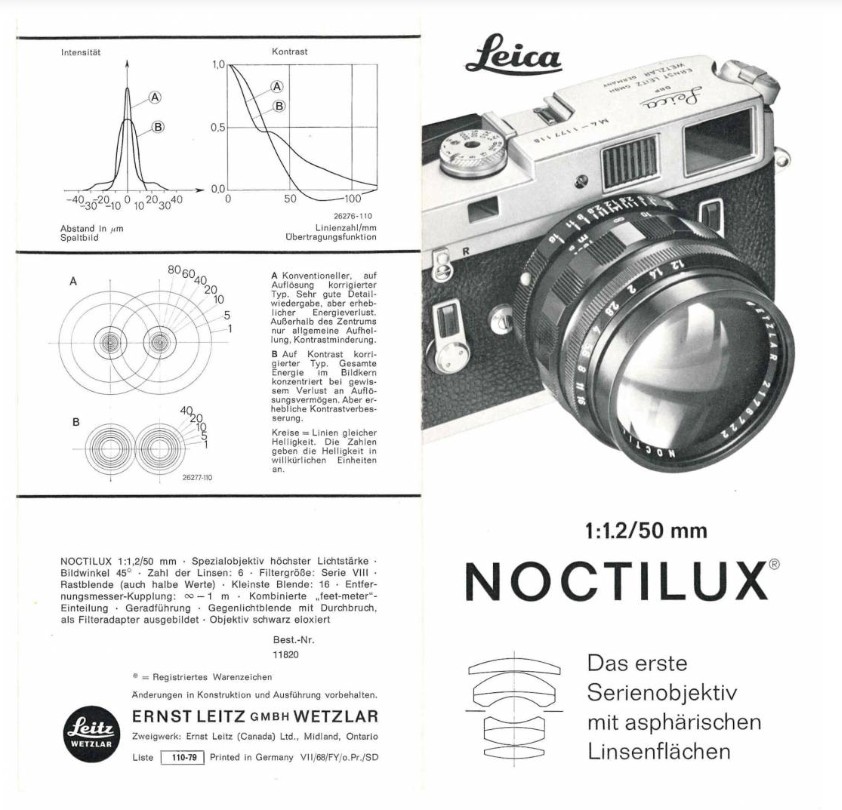
Six elements in four groups, with aspherical surfaces on the front and rear element — a Gauss variant of unusual character. The formula achieves its correction of spherical aberration at maximum aperture through the aspherical surfaces rather than through additional elements or compromised field flatness. The result is a lens that is technically imperfect by modern standards — but that produces a rendering character at f/1.2 that no subsequently designed lens has fully replicated. Sixteen aperture blades ensure that the diaphragm remains completely circular at partial stops. The original filter system used Series VII filters that dropped into the dedicated 12503 vented lens hood rather than threading onto the lens — a detail with significant practical and collector implications, to which we will return.
Rendering Character
In use, the original f/1.2 is a lens of two halves. In Jonathan Slack’s words it “almost behaves like two different lenses.” Wide open it is soft and dreamy, with visible vignetting and edges that never fully sharpen; stopped down past f/4 it takes on the incisive micro-contrast and acuity long associated with the rigid Summicron of the same era. That split personality — atmospheric and flawed wide open, genuinely sharp once closed down — is a large part of why the lens is still so prized. (Reviewed by Jonathan Slack, slack.co.uk)
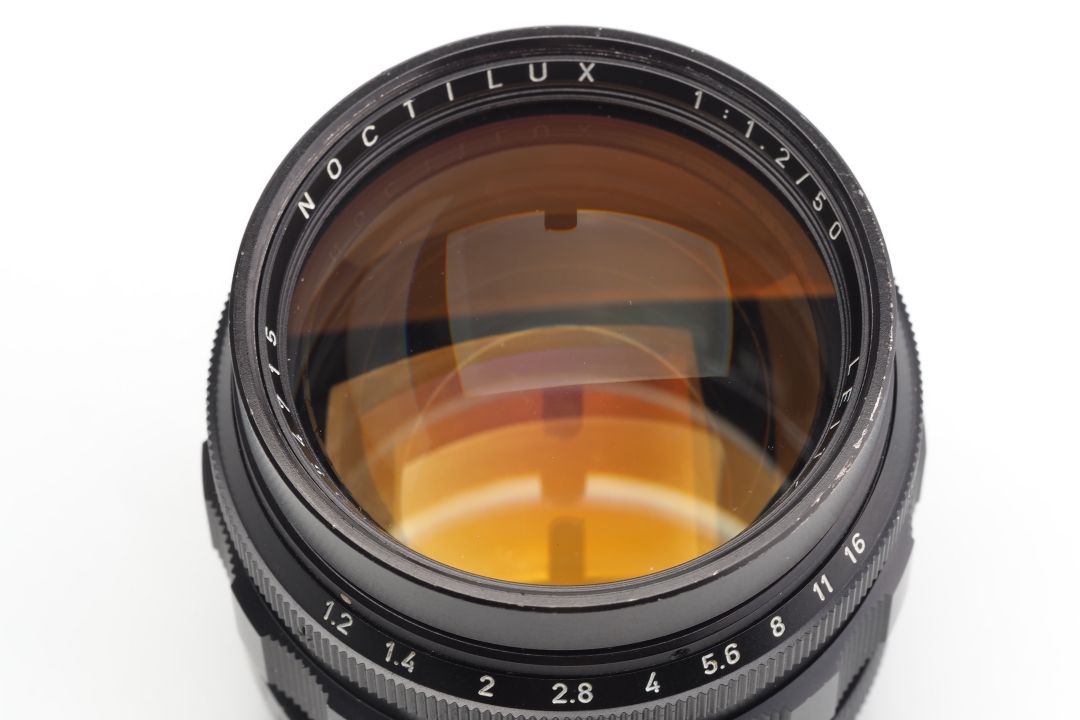
© Photo: Jo Geier Mint&Rare
1. The Chrome Prototypes
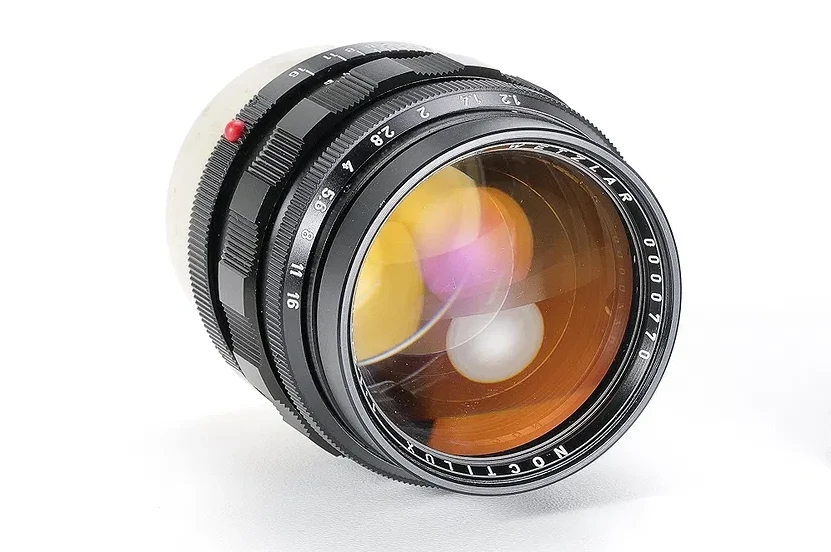
Before the Noctilux entered any form of production, Leitz assembled a small number of pre-production examples. Three distinct prototype serial number ranges are documented and known to us: 0000659 to 0000663, 0000725 to 0000734, and 0000767 to 0000770 — only approximately five of these are believed to have been produced in a silver chrome-plated finish.
Chrome was the visual language of Leitz in this period — the M2, M3, and early M4 were all available in chrome, and a chrome prototype would have been consistent with how the company presented new products to dealers and press. These were never offered for sale and were not assigned standard production serial numbers. Each represents a direct physical record of the development process of one of the most technically ambitious lenses Leitz ever attempted. They are now among the rarest and most sought-after lenses in all of Leica’s history.
2. The Black Prototypes
Within the same documented prototype serial ranges, black-finished pre-production examples were also assembled. The black prototype Noctilux shares the same non-production status — individually assembled, optically tested, not intended for sale — but signals the direction Leitz had chosen for the eventual production finish.
The decision to go black was not arbitrary. The Noctilux marked the start of Leica’s transition from silver to black-anodised lenses — a transition that would define the look of M-system equipment for the next decade and beyond. Black anodized aluminum was increasingly the preferred finish for professional and photojournalistic use, and it was the logical choice for a lens designed for available-light documentary work.
© Photo: Wetzlar Camera Auctions GmbH
3. Black Early Production — The Thick Rim Variant
The first production Noctilux f/1.2 lenses, assembled in the early stages of the run beginning in 1966, are distinguished by a characteristic that has become their primary identifier among specialists: a notably wider and thicker front rim. This early barrel design differs visibly from the later standard production version, and while the optical formula is identical, the physical presence of the thick-rim variant is unmistakable once you know what to look for.
These early examples carry the lowest serial numbers within the production run and are correspondingly the rarest of the production variants. Many were sold through Leitz dealerships in Germany, the United States, and Japan in the first years after the lens’s introduction at Photokina. Their survival rate in collector-grade condition is low — decades of professional use, service work, and the loss of original components have reduced the number of all-original, unmodified early thick-rim examples to a very small figure.
The thick rim is not merely a cosmetic distinction. It reflects a design decision that was reconsidered and revised partway through the production run — a visible reminder that Leitz was still refining the Noctilux’s physical execution even as optical production was under way.
4. Black Standard Production
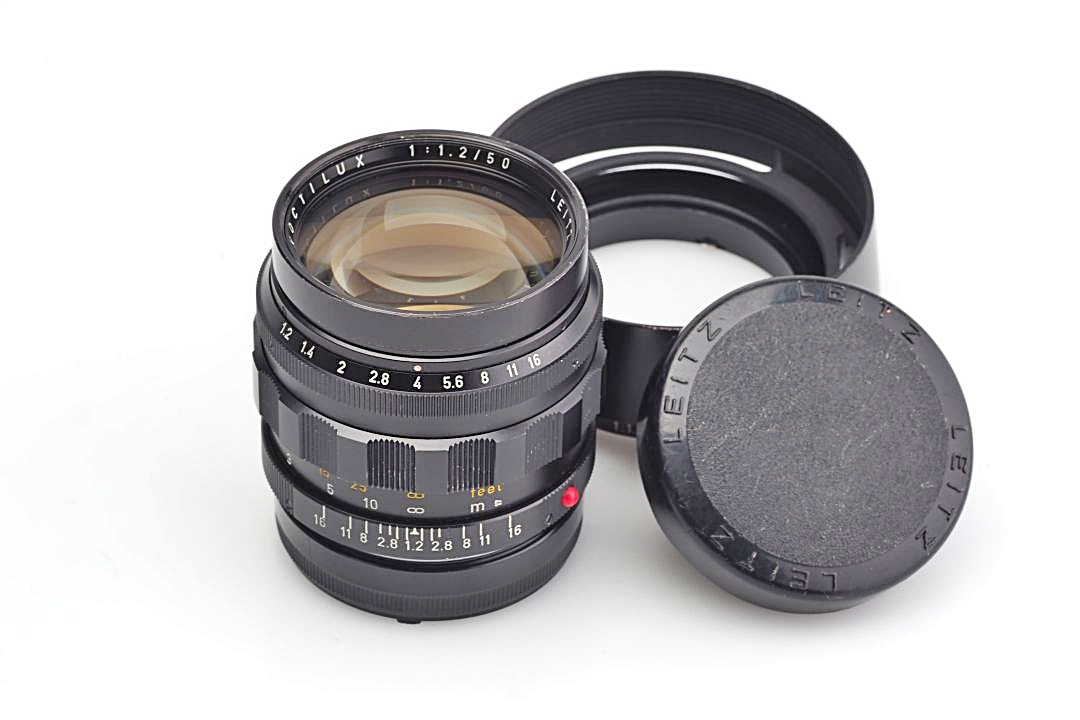
The majority of the Noctilux f/1.2 lenses produced carry what is referred to as the standard production barrel — the refined, slimmer front rim that replaced the thick-rim design partway through the run and which remained consistent through to the end of manufacture in 1975. The lens was available exclusively in black anodized aluminum — no chrome production version was offered to the general market.
Within the standard production run, several sub-variations are detectable: in aperture ring design, engraving depth and style, and minor barrel proportions. The lens used a Series VII filter installed in the Leitz 12503 lens hood rather than a conventional threaded mount. Today, the distinctive 12503 vented lens hood trades for prices that can exceed several thousand euros independently. A complete, all-original standard production Noctilux — with lens shade, caps, plexi container, warranty card and original box with matching serial numbers — represents one of the most significant assemblages in the Leica collecting world.
© Photo: Wetzlar Camera Auctions GmbH
After the release in 1966, Leitz continued research toward an f/1 version of the lens featuring three aspherical elements. That project was abandoned in 1970 because the aspherical technology was still in its infancy and the production costs were immense. The f/1.2 continued in production until 1975 — the year its replacement was designed. The Noctilux 1:1.0/50 mm 11821 with E58 filter thread mount.
5. The 2021 Chrome Re-Issue — Limited to 100 Units
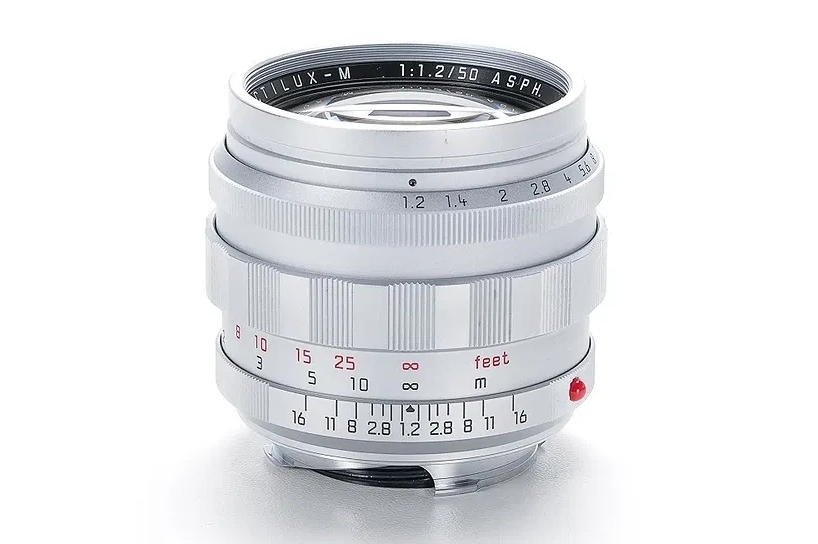
In January 2021, Leica announced the return of the Noctilux f/1.2. The re-issue’s calculation and construction adhere so closely to the original 1966 optical formula that the imaging results are almost identical — achieved through modern precision manufacturing rather than the hand-grinding process that made the original so difficult to produce consistently.
The re-issue, released with a brass body and chrome-plated finish, deliberately evoking the visual character of the pre-production prototype examples from 1964–1966, were only produced in a strictly limited edition of 100 units. Where the 1966 originals were chrome by default — chrome was simply the standard finish language of Leitz at the time — the 2021 chrome re-issue is chrome by deliberate reference: a collector piece conceived as such from the outset.
The re-issue also differs from the original in one significant practical respect: it accepts 49mm filters rather than the Series VII filters of the original. For collectors who want to compare the two side by side, this is immediately visible.
© Photo: Wetzlar Camera Auctions GmbH
6. The 2021 Black ASPH Re-Issue — Standard Production
The standard production version of the 2021 re-issue — in black anodized aluminum — is the more accessible of the two variants and the one that brought the rendering character of the original 1966 design to a broader audience for the first time.
The distinction between the original and the re-issue matters for the collector. The re-issue is a modern precision instrument that faithfully replicates an optical design — it is not the original. For users, the imaging characteristics are nearly identical. For collectors, the original will always occupy a different category: something made by hand, by a few specialists, on one machine, in limited numbers under manufacturing conditions that no longer exist.
7. The Black Paint Modern Edition
Beyond the standard black anodized and chrome re-issue versions, Leica has produced black paint editions of the modern Noctilux f/1.2 — black lacquer finishes that place the lens in visual and collecting dialogue with the legendary black paint M3, M2, and M4 bodies of the late 1950s and 1960s. These are limited, explicitly conceived as collector editions, and produced in numbers that ensure they will not become common.
Black paint on a modern lens carries different associations from the hand-applied black lacquer of a 1960s Leica body. On the original M cameras, black paint was a functional specification for professional use. On a modern edition, it is a deliberate aesthetic and collecting statement. For collectors who want a usable, optically current instrument with genuine limited-edition status — particularly in unused, boxed condition — these editions represent a compelling position in the Noctilux family.
The Line Continues — f/1, f/0.95, and f/1.25
The Noctilux f/1.2 did not end the family — it founded it. In 1975, Dr. Walter Mandler, working at Leica’s plant in Midland, Ontario, Canada, designed a replacement: the f/1 Noctilux, a seven-element, six-group design that deliberately avoided aspherical surfaces in order to achieve consistent, manufacturable quality. Launched in 1976, it remained in different versions (11821 & 11822) in production for over thirty years.
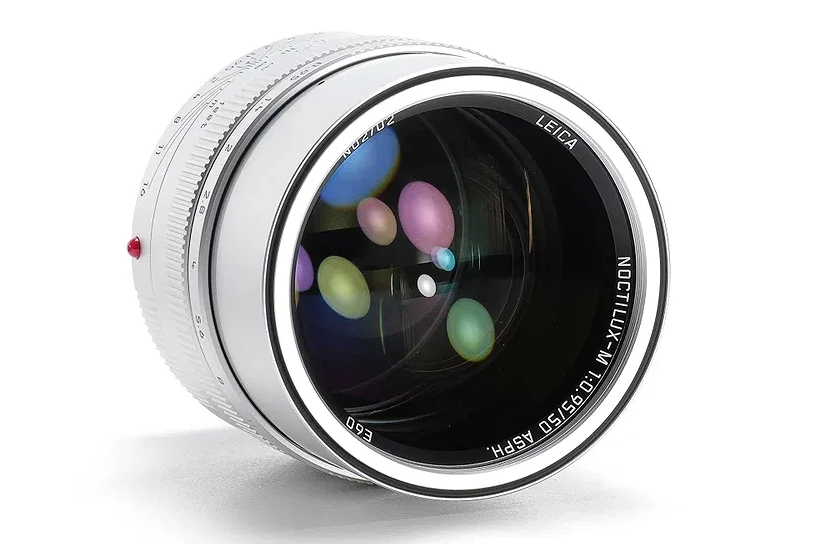
In 2008, Peter Karbe at Leica’s Wetzlar facility introduced the f/0.95 ASPH. — eight elements in five groups, with aspherical elements and glass with anomalous partial dispersion — pushing the aperture beyond f/1 for the first time using modern computer-aided design. It became the world’s fastest aspherical lens for 35mm photography at the time of its release.
The family was further extended in 2017 with the Noctilux-M 75mm f/1.25 ASPH., designed primarily for portraiture at a longer focal length. Each generation carries the name, but the original f/1.2 — with its few specialists, single machine, and hand-ground elements — stands apart from all of them.
© Photo: Wetzlar Camera Auctions GmbH
Variations at a Glance
| Chrome Prototype | silver chrome | ca. 1964 - 1966 | 5 are known, serial range 0000659 - 0000770 |
| Black Prototype | black anodized | ca. 1964 - 1966 | Within the same serial range |
| Black Early Thick Rim | black anodized | 1966 - 1967 |
Lowest production serials, extremely rare |
| Black Standard Production | black anodized | 1966 - 1975 | Series VII Filter |
| 2021 Chrome Re-Issue | silver chrome, brass | 2021 | 100 units, model 11702, filter 49mm |
| 2021 Black ASPH Re-Issue | black anodized | 2021 until present | Standard Production re-issue, filter 49mm |
| Black Paint Editions | black Paint | Limited | Limited quantities |
Version Order - Filter and Hood Reference
| V1 | E 58 | 11821 |
Hood code: 12519 |
| V2 | E 60 | 11821 | Hood code: 12539 |
| V3 | E 60 | 11821 |
Hood code: 12544 (clamp-on) |
| V4 | E 60 | 11822 | Built-in hood |
What to Look For — and What to Watch Out For
The f/1.2 Noctilux is one of the most frequently misrepresented lenses on the secondary market. Several issues recur consistently enough that any serious buyer should know them before handling an example.
All-original components matter significantly. The Series VII lens shade for the original — the 12503 vented hood — is now worth several thousand euros independently, a figure that tells its own story about completeness. Original caps, the original plexi container, warranty card and box, all contribute substantially to value.
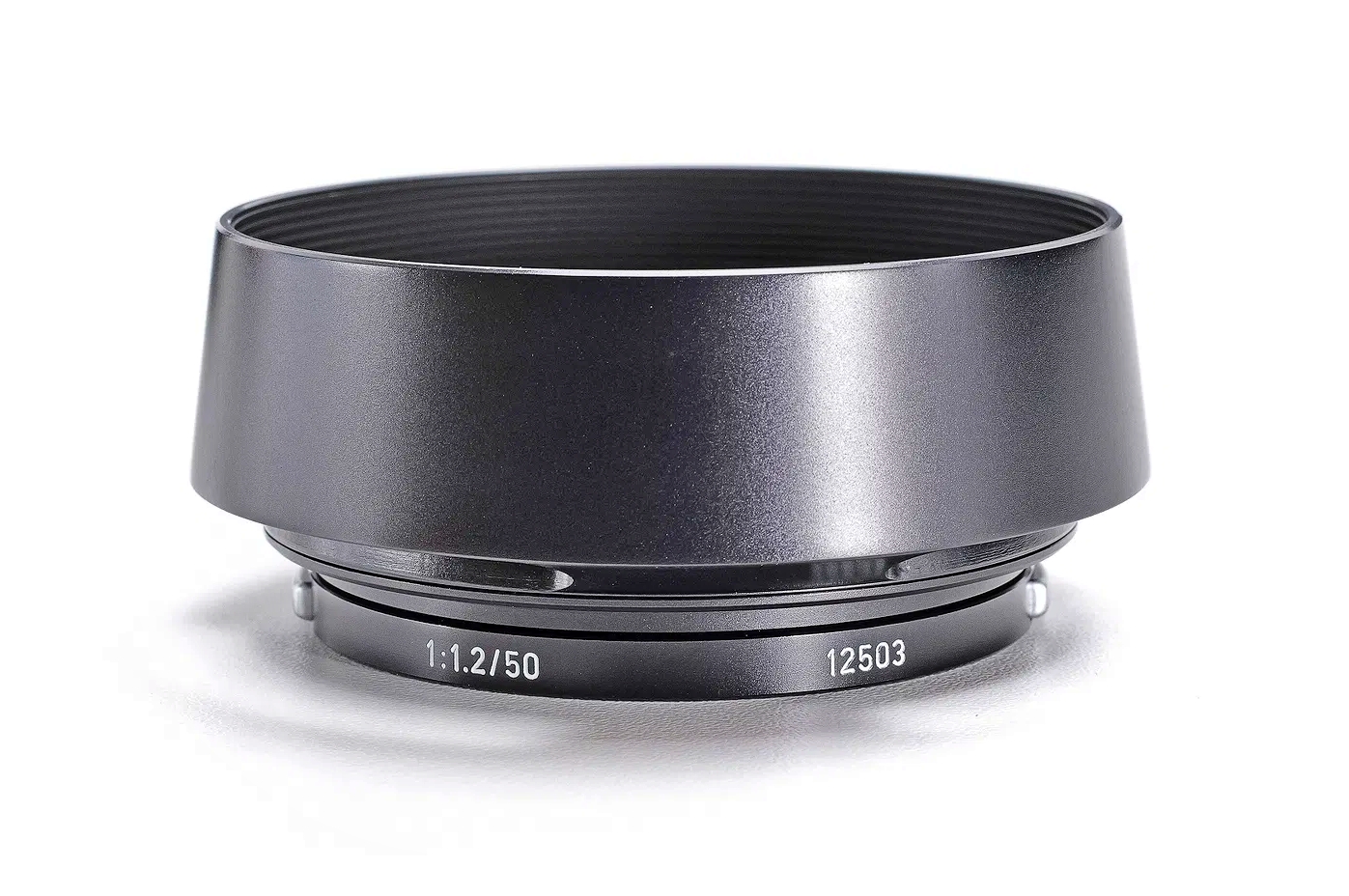
© Photo: Wetzlar Camera Auctions GmbH
Distinguish original from re-issue: the 2021 re-issue accepts standard 49mm filters; the original uses Series VII. This is the fastest single check when examining an unknown example. Besides its serial number of course.
Do You Own a Noctilux f/1.2?
At Mint & Rare, Jo Geier has hand held examples of every variant described in this article. We are always actively looking for further pieces — particularly chrome and black prototype versions, early thick-rim examples in all-original condition, and complete standard production sets with original hood, caps, plexi container, and box. If you own a Noctilux f/1.2 in any version and are considering selling, we would be genuinely interested to hear from you.
We buy privately, discreetly, and at prices that reflect the true significance of what we are being offered.
Mail: info@jogeier.com
Whats'App & Phone +43 1 890 4003
-
 Why collectors love the black-paint Leica IIIf. The Swedish Army model: a rare collector’s guide
-
 Wetzlar Camera Auctions - Shorts - October 10th 2026
-
 Leicas of the CEO: Leica M7 Titanium, Black M7 & MP – Jo Geier – Mint & Rare
-
 Two Leica M4 Black Paint Cameras — Early vs. Later – Jo Geier – Mint & Rare
-
 Jeicy Camera Works & Konica FR Prototype: Rare Leica Copies from Japan – Jo Geier – Mint & Rare